Blog / Artificial Intelligence
How many students use AI regularly in 2026? Adoption, weekly use, and the literacy gap

XXXFuel Editors
20 min read
Most students have used AI. About half use it every week. DEC 92%, College Board 84%, Pew teens 30% daily, HEPI UK 95%. Charts, sources, and why 84% is not 24%.

The honest short answer: most students have used AI, and about half use it every week. That is not one survey. It is three different populations that should not be averaged.
The Digital Education Council’s 2024 Global AI Student Survey (3,839 bachelor’s, master’s, and doctoral students in 16 countries) found 86% already using AI in their studies, with 54% on a weekly cadence and 24% every day. DEC’s 2026 follow-up put ever-use at 92% and weekly-or-daily use at 67%. In U.S. high schools, College Board measured GenAI-for-schoolwork at 79% in January 2025 and 84% in May 2025, with 69% using ChatGPT specifically. Pew Research Center, asking U.S. teens 13–17, found 64% had used an AI chatbot by late 2025 and 30% used one daily. In the UK, HEPI’s 2026 undergraduate survey (1,054 full-time students, Savanta, December 2025) put any AI use at 95%.
Whatsthebigdata’s roundup of the same question stops at mid-2025 and leans on a single global student poll. The picture in 2026 is bigger, more split by age, and more awkward for campuses: use is default, training is not, and “cheating” is a worse label than the data supports.
92%Students who have used AI · DEC 2026 (86% in 2024)
54–67%Weekly or more · DEC 2024 / 2026
84%U.S. high schoolers using GenAI for schoolwork · College Board, May 2025
30%U.S. teens using an AI chatbot daily · Pew, late 2025
Snapshot
Key student AI usage statistics, 2024–2026
- 86% → 92% of higher-ed students have used AI in their studies (DEC 2024 global, n=3,839 in 16 countries; DEC 2026 follow-up).
- 54% used AI weekly in 2024; 24% daily (DEC 2024). Weekly-or-daily rose to 67% in the 2026 follow-up.
- Tyton Partners, Time for Class 2026: more than half of U.S. students, faculty, and administrators use AI at least weekly. Daily GenAI: 32% of students, 25% of faculty, 43% of administrators.
- College Board (Oct 2025): U.S. high school GenAI-for-schoolwork 79% (Jan 2025) → 84% (May 2025). 69% used ChatGPT for assignments. About half used AI to brainstorm, revise essays, or find sources.
- Pew, Jan 2025: U.S. teens using ChatGPT for schoolwork 13% (2023) → 26% (2024).
- Pew, Dec 2025 (n=1,458 teens, 25 Sep–9 Oct 2025): 64% ever used a chatbot; 30% daily; ChatGPT 59%, Gemini 23%, Meta AI 20%.
- Pew, Feb 2026: just over half of U.S. teens had used chatbots for schoolwork; 12% for emotional support.
- HEPI 2026 (UK undergrads): 95% used AI in at least one way; 94% used generative AI on assessed work; 12% pasted AI text into assessments (3% in 2024, 8% in 2025).
- DEC 2024: ChatGPT 66%, Grammarly 25%, Microsoft Copilot 25%. 58% said they lack AI knowledge; 80% said their university’s AI integration falls short; 73% want training.
- Stanford GSE / Challenge Success: high-school cheating in the prior month stayed in the 60–70% band after ChatGPT launched. AI did not invent the integrity problem.
The headline number
How many students use AI regularly?
“Regularly” is doing too much work in most headlines. If you mean ever used, you are in the high 80s and 90s. If you mean every week, you are in the 50s and 60s. If you mean every day, you are in the mid-20s to low-30s. Mixing those three is how a directory page turns into a press-release.
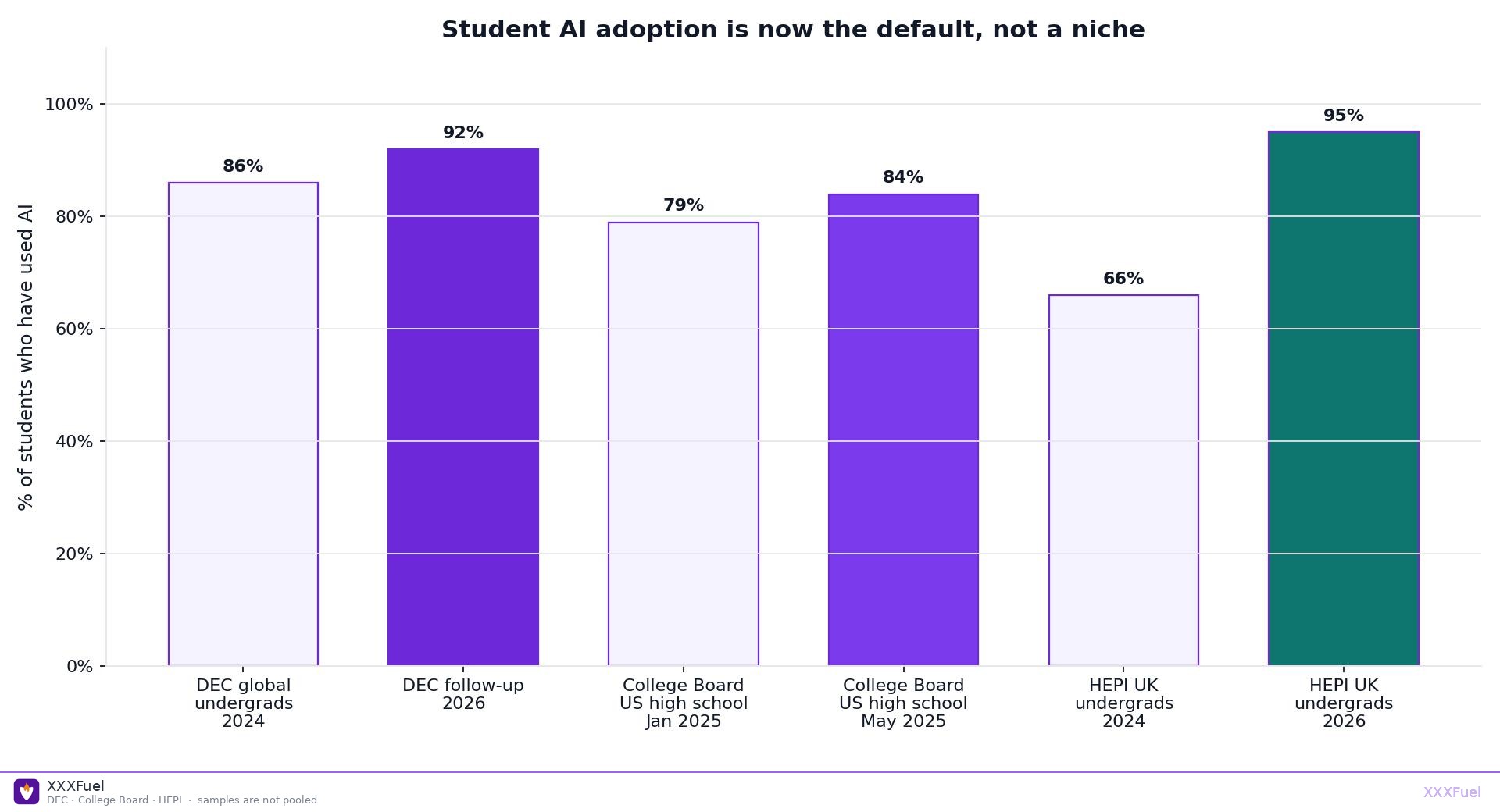
DEC’s 2024 global poll is still the cleanest international number for higher education: 86% of students used AI in their studies. Campus Technology and DEC’s own write-up both publish that figure against a sample of 3,839 students across bachelor’s, master’s, and doctoral programs in 16 countries. The 2026 DEC follow-up — the one that put ever-use at 92% and weekly-or-daily at 67% — is a later wave, not a reason to pretend 2024 never happened. Cite both.
UK undergraduates are further along than the global mean. HEPI’s 2026 survey, fielded by Savanta in December 2025 among 1,054 full-time UK undergraduates, found 95% using AI in at least one way, against 66% in HEPI’s 2024 wave. That is a country with a national student-union conversation and three years of published guidance. It is not a proxy for U.S. community colleges.
Ever used
86–95% depending on the sample. DEC 2024 global HE 86%. DEC 2026 92%. HEPI UK 2026 95%. College Board U.S. high school (schoolwork) 84%.
DefaultNot weekly
Weekly or more
About half to two-thirds. DEC 2024: 54% weekly (24% of that daily). DEC 2026: 67% daily or weekly. Tyton 2026: more than half of U.S. students weekly.
The real “regular”Homework loop
Cadence
Daily, weekly, and the Tyton tipping point
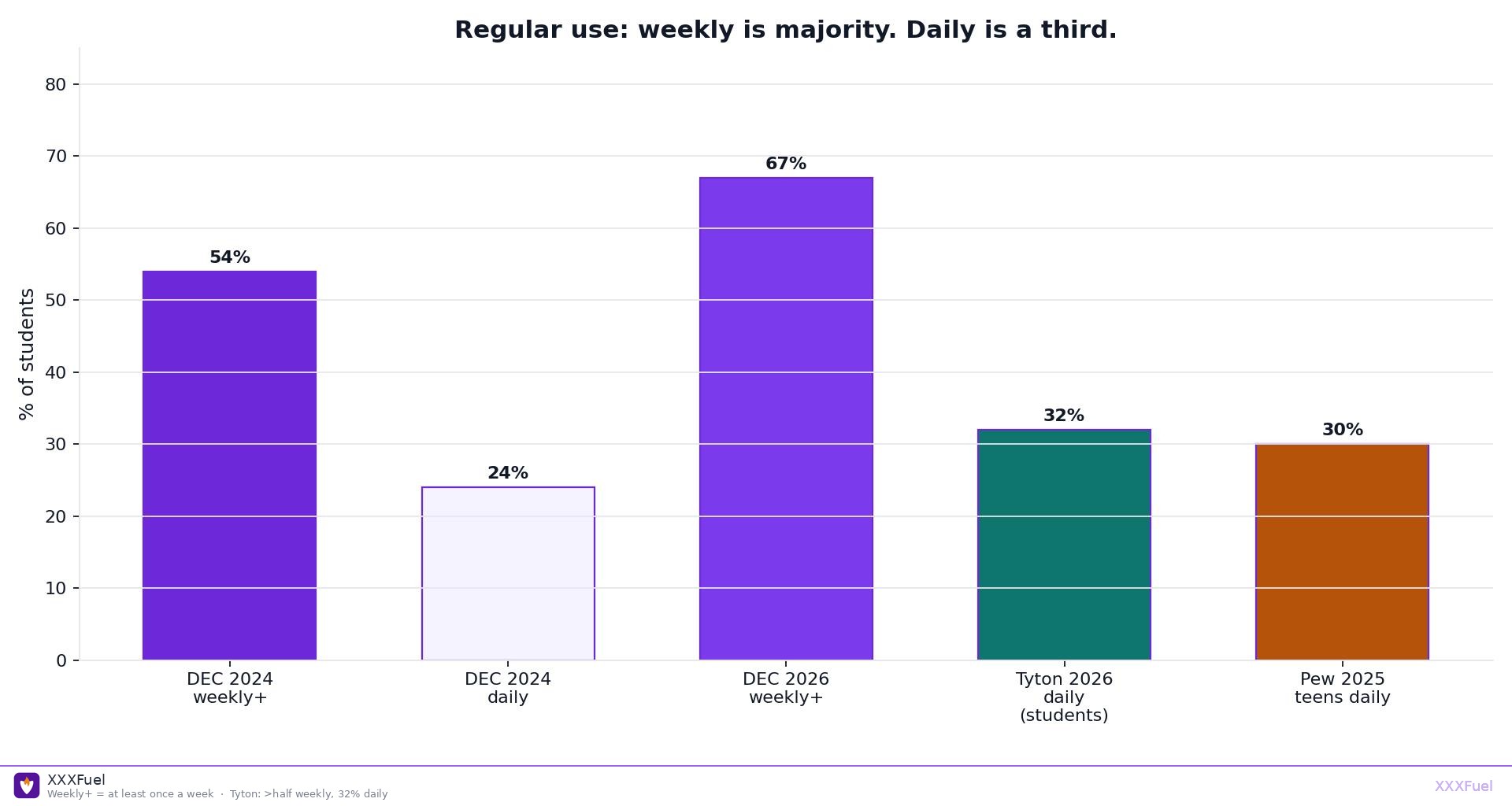
DEC 2024 is still the citation for the weekly split: 54% of students used AI tools daily or weekly, including 24% every day and about 30% weekly. That is the number most “how many students use AI regularly” pages are quietly recycling. It is a 2024 global higher-ed sample. Treat it as a floor, not a 2026 U.S. high-school rate.
Tyton Partners’ Time for Class 2026 is the better U.S. campus update. For the first time, more than half of administrators, faculty, and students used AI at least weekly. Daily GenAI sat at its highest point since Tyton started asking in spring 2023: 43% of administrators, 32% of students, 25% of faculty. The 2025 Time for Class wave had students, admins, and instructors closer to the low-40s for weekly-or-daily use. One year later, the student daily figure is the one to steal for a chart — 32% — not the 24% from DEC’s older global poll.
Teens are not a milder version of undergraduates. Pew’s late-2025 teen survey put daily chatbot use at 30%, including 16% who used a bot several times a day or almost constantly. That is a phone habit, not a term-paper habit. Older teens (15–17) used chatbots more than 13–14-year-olds (68% vs 57% ever; 31% vs 24% daily). Household income and race split the same way tech access always does: 66% of teens in $75,000+ households used a chatbot versus 56% under $30,000; Black and Hispanic teens were more likely than White teens to have used one (70% vs 58%) and to use one daily (35% / 33% vs 22%).
The stack
ChatGPT still wins. Gemini and Meta AI are the teenage second screen.
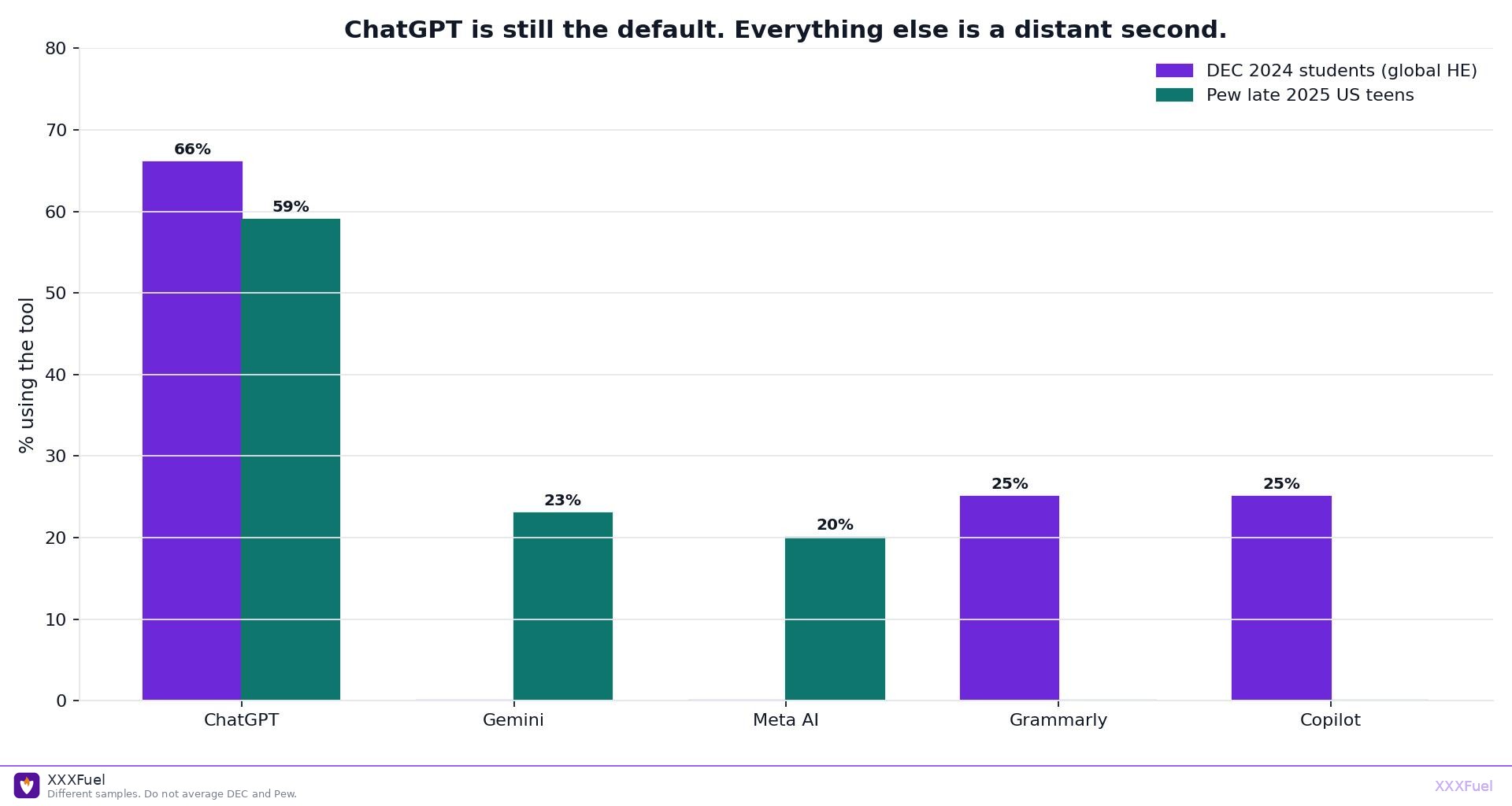
DEC 2024 still has the student-tool table everyone copies: ChatGPT 66%, Grammarly 25%, Microsoft Copilot 25%. Among frequent users in DEC’s 2026 follow-up, ChatGPT rose to 88%, with Gemini, NotebookLM, Grok, Claude, and Cici showing up as secondary apps. That is a product map, not a ranking you can turn into market share.
Pew’s teen instrument is more useful for 2026 because it names the bots people actually open. ChatGPT (59%) was the only chatbot a majority of U.S. teens used. Gemini (23%) and Meta AI (20%) were less than half that. Copilot, Character.AI, and Claude sat in the “fewer say they use” bucket. Higher-income teens over-index on ChatGPT (62% in $75,000+ households). Lower-income teens were more likely to use Character.AI (14% vs 7%). If you are writing a school-policy memo, Character.AI is not a rounding error. If you are writing an SEO page, ChatGPT is still the query.
| Tool | Who was asked | Share |
|---|---|---|
| ChatGPT | DEC 2024 global HE students | 66% |
| ChatGPT | Pew late 2025 U.S. teens | 59% |
| ChatGPT | College Board May 2025 U.S. high school (homework) | 69% |
| Gemini | Pew late 2025 U.S. teens | 23% |
| Meta AI | Pew late 2025 U.S. teens | 20% |
| Grammarly | DEC 2024 global HE students | 25% |
| Microsoft Copilot | DEC 2024 global HE students | 25% |
High school
84% is a College Board number, not a vibe
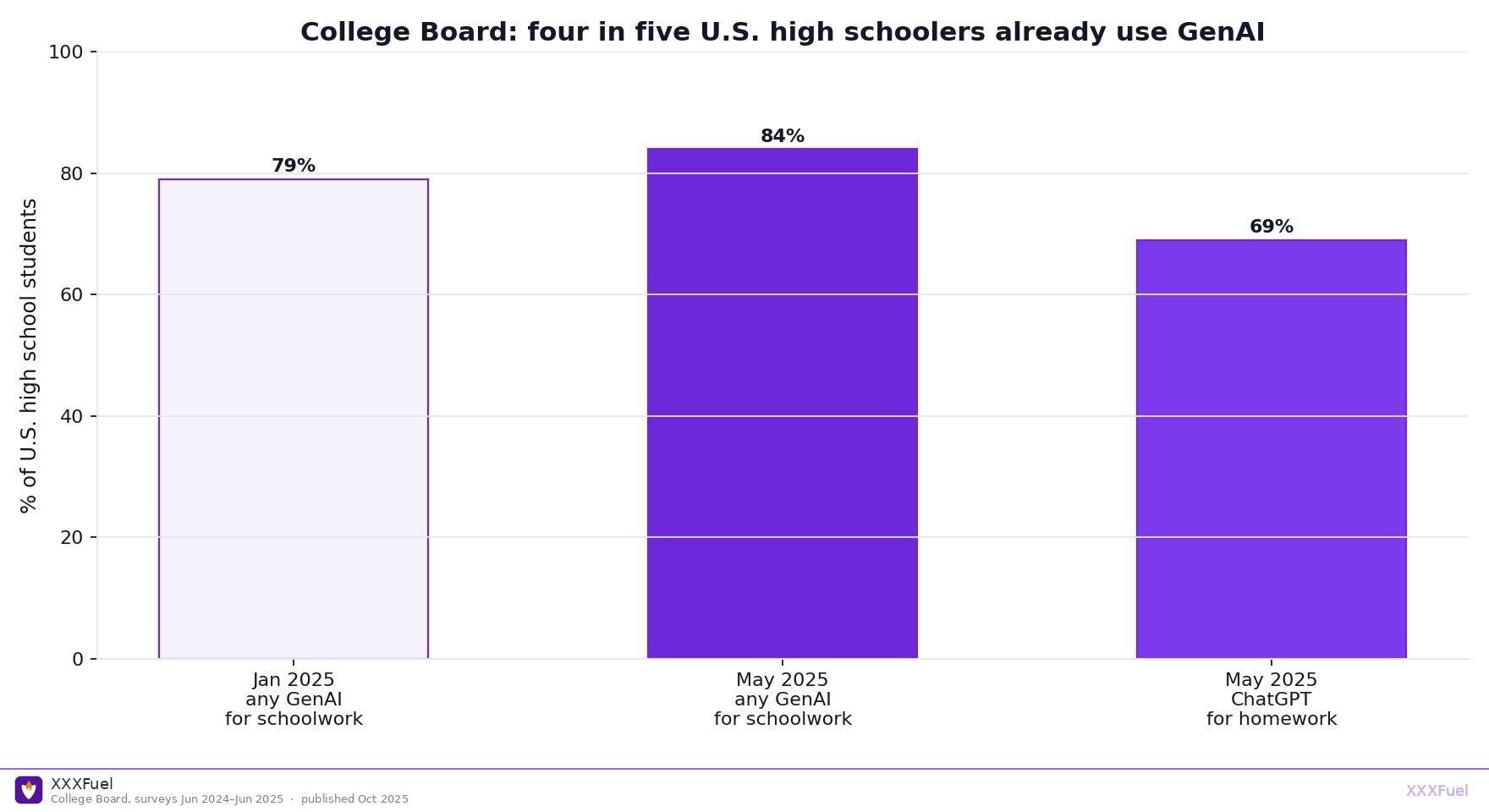
College Board’s October 2025 brief is the U.S. high-school source that should replace recycled “84% of students” tweets. The surveys ran June 2024 to June 2025. GenAI-for-schoolwork rose from 79% in January 2025 to 84% in May 2025. 69% of students used ChatGPT on assignments and homework in May. About half used AI to brainstorm, edit or revise essays, and/or research sources. Those are schoolwork tasks. They are not “wrote the whole paper.”

The adult half of the same brief is the part directory pages skip. Nearly six in ten of the educators College Board asked agreed it is better for students to use GenAI for schoolwork than not to. More than 85% called learning AI tools a valuable part of high school. And then the policy: 55% of principals said their school had not blocked GenAI on the network; about two in five schools or districts still did not allow student use; about one in five allowed it with no policy; only 13% encouraged it in all classes. Students did not wait for the PDF.
Do not mix these
High school 84% is not undergraduate 86%
College Board asked U.S. high schoolers about GenAI for schoolwork. DEC asked global university students about AI in their studies. Pew asked U.S. teens about chatbots, then, separately, about ChatGPT for schoolwork. An 84, an 86, and a 26 can sit on the same page. They cannot sit in the same cell of a table.
Teens
From 13% ChatGPT-for-homework to a majority chatbot habit
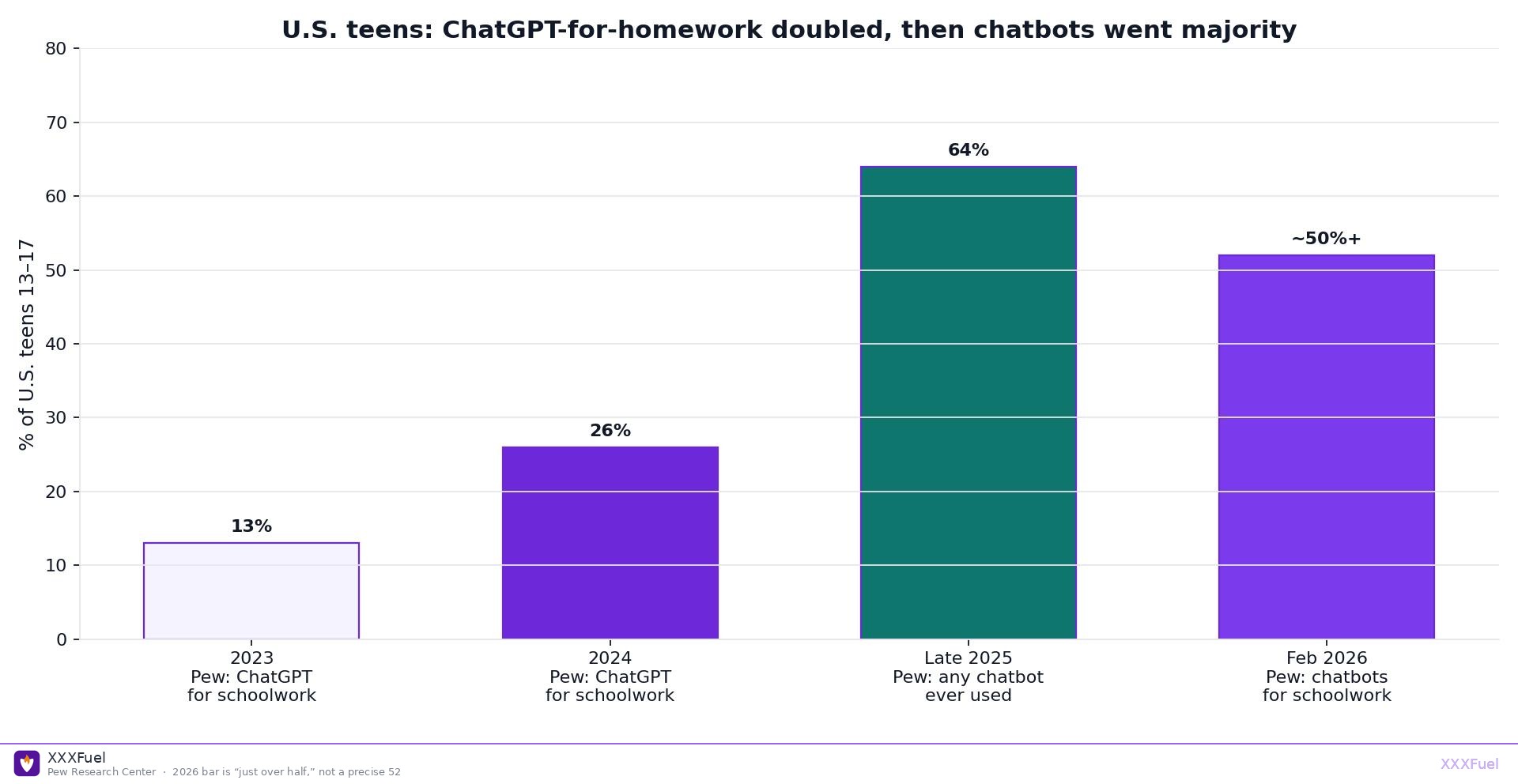
Pew is the only U.S. teen series with a real time axis. In 2023, 13% of teens 13–17 had used ChatGPT for schoolwork. By late 2024 that doubled to 26% (Pew, published 15 January 2025). Among teens who used it, 54% used it for research, 29% for math, 18% for essays. That 26% is still the number a lot of 2025 explainers freeze on. It is two instruments behind.
By 25 September–9 October 2025, Pew’s next teen wave (n=1,458, Ipsos KnowledgePanel) found 64% had ever used an AI chatbot and 30% used one daily. In February 2026 Pew reported that just over half of U.S. teens had used chatbots for schoolwork help, with 12% using them for emotional support. The schoolwork figure is a different question from 2023’s ChatGPT-only item. Plot them as a family of measures, not a single line.
| Pew question | When | Share of U.S. teens 13–17 |
|---|---|---|
| Used ChatGPT for schoolwork | 2023 | 13% |
| Used ChatGPT for schoolwork | 2024 | 26% |
| Ever used an AI chatbot | Sep–Oct 2025 | 64% |
| Use a chatbot daily | Sep–Oct 2025 | 30% |
| Used chatbots for schoolwork help | By Feb 2026 | Just over half |
| Used chatbots for emotional support | By Feb 2026 | 12% |
Why they open it
Time, quality, and a 3 a.m. teaching assistant
DEC 2024 asked why. 51% of students used AI to save time; 50% to improve work quality. Instant support (40%), personalized help (32%), and help outside teaching hours (29%) sat in the next band. Skill-building was split by gender: 36% of men and 22% of women said they used AI to get better at AI. Only 13% said they used it because the institution encouraged them. 7% had no interest. The campus did not drive this. The deadline did.
HEPI 2026 rhymes. 49% of UK undergraduates said AI had improved their student experience — time, understanding, instant support. 68% called AI skills essential. 15% had used AI for companionship, advice, or loneliness. On loneliness itself the sample split down the middle: 20% said AI made them lonelier, 21% said it made them less so. That is a wellbeing story, not a homework story, and it belongs on a different slide.
College Board’s high-school use cases are more concrete than most “students use AI” infographics: brainstorming, revising, finding sources. Teachers in the same universe recommended ChatGPT far more than anything else — DEC’s faculty-adjacent figures that still circulate put teacher recommendations around 47% ChatGPT, with Google Lens, Duolingo, Gemini, and Siri in the 20s. Treat those as a 2024–25 snapshot of what adults were willing to name, not a 2026 install share.
Integrity
Pasting is up. Cheating was already the floor.
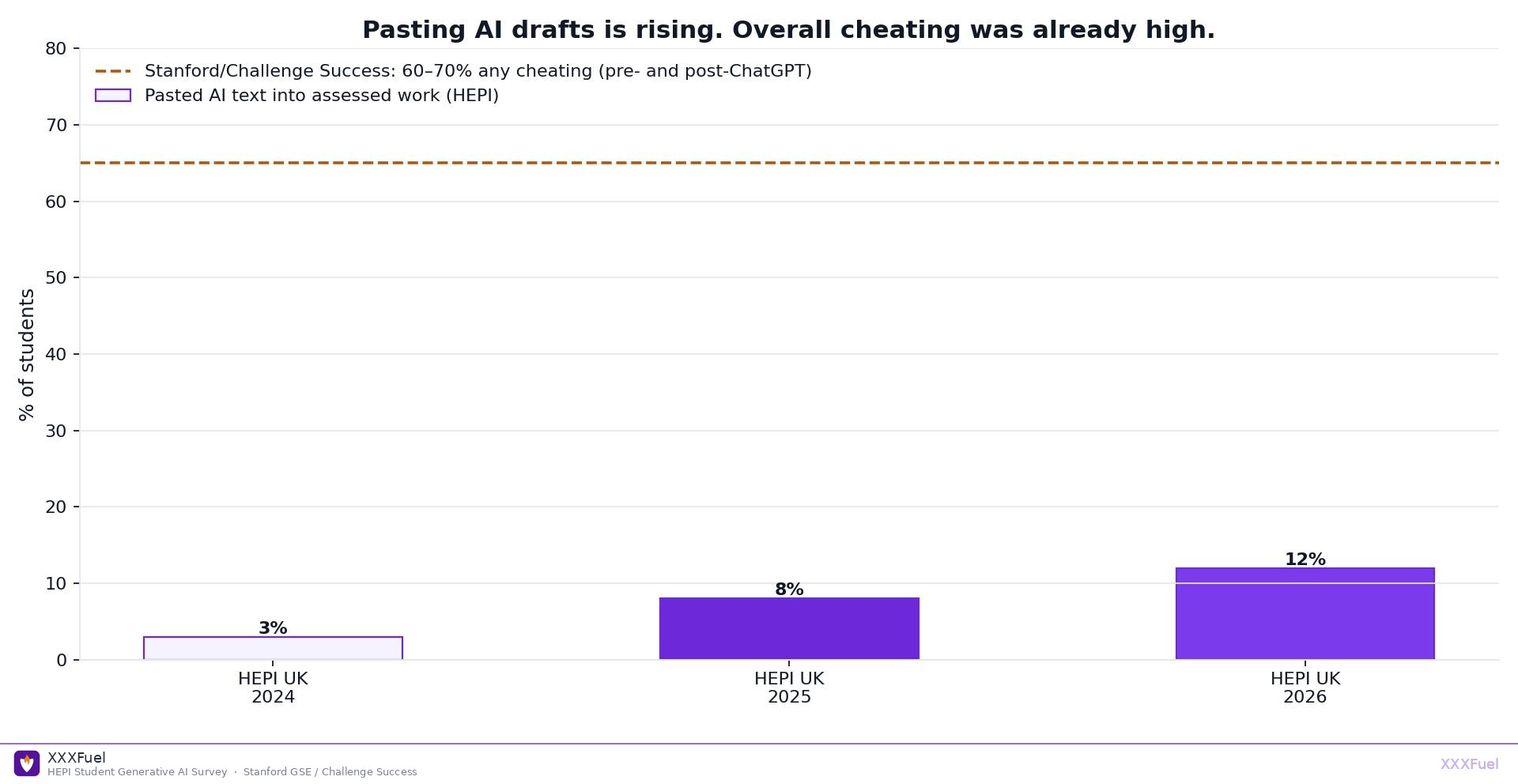
HEPI is the only national series that asks, three years running, whether students directly included AI-generated text in assessed work. The share is 3% in 2024, 8% in 2025, 12% in 2026. That is a real rise. It is also not 84%. Most students who use AI on an assignment are outlining, summarizing, or checking — the College Board half — not dumping a raw completion into Turnitin.
Stanford Graduate School of Education and Challenge Success have been the wet blanket on the “AI created a cheating epidemic” headline since 2023. High-school students reporting at least one cheating behavior in the prior month sat in the 60–70% range before ChatGPT and stayed there after. A later Challenge Success integrity study of nearly 30,000 high schoolers put unauthorized AI aid at 32.8% — almost identical to the 32.7% who copied someone else’s homework. The new tool slotted into an old distribution.
HEPI 2026 adds the student-side fear: anxiety about false accusations, and a campus that changed assessment for 65% of respondents. If your integrity policy is “don’t use ChatGPT” in a year when 94% of UK undergrads use generative AI on assessed work, you are writing a rule students cannot follow and staff cannot mark.
The gap
Students adopted. Universities published a PDF.
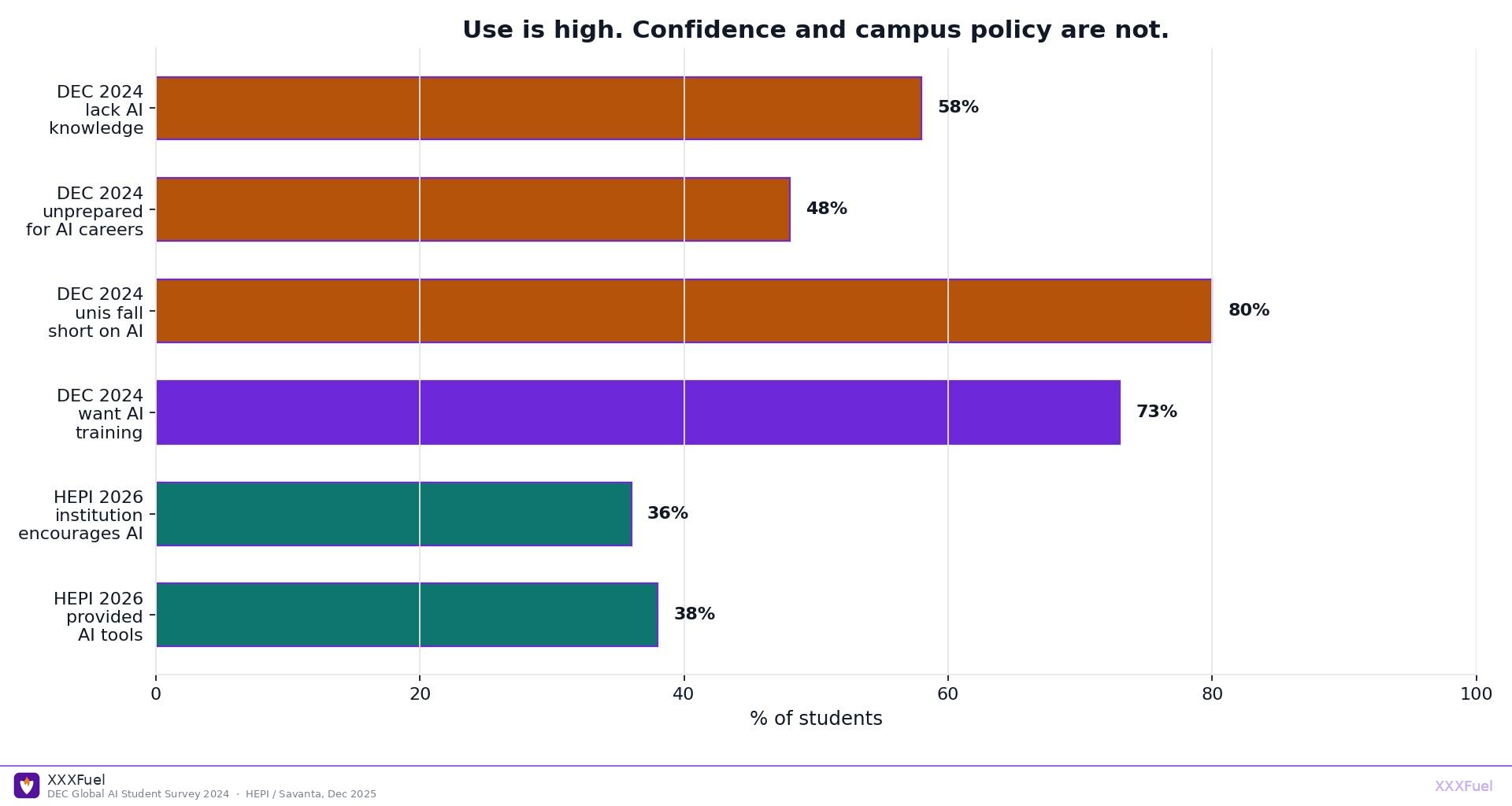
DEC 2024 is blunt. 58% of students said they lacked sufficient AI knowledge and skills. 48% felt unprepared for AI-driven careers. 80% said their university’s integration of AI tools did not meet expectations. 73% wanted the university to provide AI training. Only a small slice — on the order of 13% in DEC’s motivation table — said they used AI because the institution encouraged it.
HEPI 2026 shows the gap did not close just because use went to 95%. 48% felt teaching staff were helping them build AI skills for a career. 36% felt the institution encouraged AI use (37% agreed, 36% disagreed — a coin flip). 38% said the institution provided AI tools, up from 23% in 2025 and 9% in 2024. Provision is moving. Culture is not. Arts and humanities students were the most likely to feel under-supported.
That is the traffic story hiding under the adoption story. Parents search “how many students use AI.” Faculty search “AI cheating statistics.” Students search “chatgpt for homework” (Google Ads U.S. volume still hundreds to low thousands a month, peaking in term time). The page that ranks is the one that separates used it, use it weekly, and pasted it into the essay, then tells the university it is late.
Read this first
Five rules so you do not launder the surveys
- Do not average DEC, Pew, College Board, Tyton, and HEPI. They ask different ages, in different countries, about different verbs (used AI / used a chatbot / used GenAI for schoolwork / used ChatGPT for homework).
- “Regularly” means weekly unless you say daily. DEC 2024 weekly-or-daily is 54%. Daily is 24%. Tyton 2026 student daily is 32%.
- 84% is College Board high school, May 2025, schoolwork. It is not “84% of all students worldwide use ChatGPT every day.”
- 12% pasted. 94% used. HEPI’s integrity item is the paste rate. The use rate is an order of magnitude larger.
- ChatGPT is the brand. Chatbots are the category. Pew’s 59% ChatGPT (teens, late 2025) and 64% any-chatbot are cousins, not duplicates.
Citations
Sources
- Digital Education Council, Global AI Student Survey 2024 — 3,839 students, 16 countries. 86% use, 54% weekly, 24% daily, ChatGPT 66%, literacy gap (58 / 48 / 80 / 73).
- Digital Education Council, 2026 follow-up — 92% use, 67% daily or weekly; ChatGPT 88% among frequent users.
- College Board, “Majority of High School Students Use Generative AI for Schoolwork,” 6 Oct 2025 — 79% → 84%; 69% ChatGPT; policy and principal figures.
- Pew Research Center, 15 Jan 2025 — U.S. teens ChatGPT-for-schoolwork 13% (2023) → 26% (2024); research 54%, math 29%, essays 18%.
- Pew Research Center, “Teens, Social Media and AI Chatbots 2025,” 9 Dec 2025 — n=1,458, 25 Sep–9 Oct 2025. 64% ever, 30% daily, ChatGPT 59%, Gemini 23%, Meta AI 20%.
- Pew Research Center, “How Teens Use and View AI,” 24 Feb 2026 — just over half used chatbots for schoolwork; 12% emotional support.
- Tyton Partners, Time for Class 2025 and 2026 — 2025: ~42% students weekly/daily. 2026: majority weekly; 32% of students daily.
- HEPI / Savanta, Student Generative AI Survey 2026 (published 12 Mar 2026; fielded Dec 2025; n=1,054 UK undergraduates) — 95% any use, 94% on assessed work, 12% paste (3 / 8 / 12), 38% provided tools.
- Stanford GSE / Challenge Success — cheating 60–70% pre- and post-ChatGPT; later ~30k-student integrity wave, unauthorized AI 32.8% vs copied homework 32.7%.
- DataForSEO, Google Ads search volume, United States, English, retrieved 27 Aug 2026 — “chatgpt for homework” and related queries; term-time seasonality.
FAQ
Questions people actually type
How many students use AI regularly in 2026?
Treat weekly as “regularly.” DEC: 54% of global higher-ed students in 2024, 67% daily or weekly in the 2026 follow-up. Tyton 2026: more than half of U.S. higher-ed students weekly, 32% daily. Pew: 30% of U.S. teens use a chatbot daily. Ever-use is 86–95% and is the wrong headline.
What percentage of high school students use AI?
College Board (May 2025): 84% of U.S. high school students used generative AI for schoolwork, up from 79% in January. 69% used ChatGPT on assignments. About half used it to brainstorm, revise, or research.
How many teens use ChatGPT for homework?
Pew: 13% in 2023, 26% in 2024, for ChatGPT specifically. By February 2026, just over half of U.S. teens had used chatbots (not only ChatGPT) for schoolwork. Late 2025 Pew: 59% of teens used ChatGPT at all, not only for homework.
Are students cheating more because of AI?
HEPI’s paste-into-the-essay rate rose 3% → 8% → 12% (2024–26). Stanford / Challenge Success found overall high-school cheating stayed in a 60–70% monthly band after ChatGPT. Unauthorized AI aid later tracked copied homework at ~33%. Use exploded. The cheating floor was already high.
Which AI tool do students use most?
ChatGPT, in every large survey: 66% of DEC 2024 students, 69% of College Board high schoolers (homework, May 2025), 59% of Pew teens (late 2025). Gemini and Meta AI are the teen runners-up. Grammarly and Copilot still show up in higher-ed stacks.
Do universities teach students how to use AI?
Not at the rate students want. DEC 2024: 80% said integration fell short, 73% wanted training. HEPI 2026: only 36% felt encouraged, 38% were provided tools (up from 9% in 2024). The adoption curve ran ahead of the faculty-development curve.
Last updated 27 August 2026. Figures are from named surveys with sample frames in the citations. If a vendor deck averages them, it is wrong.
More from the desk
How to Make an AI Girlfriend: The Actual Build Order
Appearance last. Personality first. Scenario as the memory spine. Then voice, memory, and who actually keeps her. A 2026 build order for Candy, Character.AI, CrushOn, and Nomi — including the free path.
22 min read

Who Owns the AI Character You Just Built?
You spent a night on her. You probably do not keep her. Character.AI, Candy, SpicyChat, Nomi, CrushOn — who actually owns the AI girlfriend you just built, in the terms they already published.
17 min read
Best AI girlfriend apps in 2026
Character.AI, Kindroid, SpicyChat, CrushOn, Replika, Chai, Talkie, Muah, Candy, and Nomi — grouped by what they actually do, with live pricing caveats.
4 min read